Monday, 18 May 2020

Man ostracised after Covid-19 screening, lives on a hillock for seven days


shanmughasundaram.j @timesgroup.com
Chennai: 
For the last one week, 28-year-old Shamim Ali has spent days and nights on a hillock on the outskirts of his village, Kannagapattu in Thiruporur. A guest worker from Uttar Pradesh's Kannauj district, he had taken up loading and unloading work at the Koyambedu market and was taken for Covid-19 screening in the first week of May. As he was not infected, he was advised home quarantine, and that was when reality set in. His villagers refused to allow him to stay at home forcing him to spend seven days on the village outskirts amidst trees and shrubs. 

Ali had made MGR Nagar in Kannagapattu his home for four years after arriving in the state in search of a job. A father of four children, he and his family was residing in a single-room house with asbestos roofing. He was working in a papermart until the nation-wide lockdown to prevent Covid-19 spread rendered him jobless. As a result, he found his way to the Koyambedu market to load and unload vegetables for a few days. 

However, the emergence of a Covid-19 cluster with Koyambedu market at the epicentre not only left him without a job a second time, but also led to his ostracisation. “Officials traced me along with three others from the same locality as we worked in the market. We were screened and advised to stay at home. When I returned, the locals feared that I might be carrying the virus and could spread the infection. They told me to stay away from the village,” Ali said. 

With no place to go, Ali took shelter near a temple on a hillock in the vicinity. The villagers did not stop with this. They dissuaded his wife from visiting him. His younger brother, Khalil Ali, who is living with his family in the same vicinity, dropped food for him a few meters away from the place he stayed from May 10 to the morning of May 16.

Finding it difficult, Ali got in touch with his friend, Chand Ali, to help him get back to his family, “I, with the help of a volunteer, Rahul, contacted revenue officials and sought help for Shamim Ali,” Chand Ali said.

Revenue Inspector of Tiruporur N Pushpa Rani along with police officials reached the village on Saturday morning. “We spoke to the villagers and tried to ward off their fears. We convinced them to allow him to stay at his home. Later, he returned home,” she said. 

“It was very difficult for me to stay away from my children. I missed them a lot, and I was very happy to get back to them,” Ali said. Despite the government trying to create awareness among the public on Covid-19, people like Ali continue to face social stigma in the state./eom/shan/

Guest workers take the weary journey, only to be dropped back


Shanmughasundaram.j@timesgroup.com
Chennai:

Sathish Garg and 10 of his friends started their homeward journey by foot on May 14. Losing his job as a carpenter post-lockdown, Garg decided to walk to his hometown in Kanpur from Redhill where he had worked for nearly three years. But Garg and his friends were ferried back not once but twice after they were spotted by Andhra Pradesh police; the first time at Tada, and the second time at Sullurpeta.

“We reached Tada on May 15, a day after we started to walk. The AP police put us in a truck and dropped us back at Redhills. Where can we go? So, we started to walk again as we had no choice. But again, we were stopped by the police at Sullurpeta on Saturday, and we ended up at a government shelter in Gummidipoondi,” Garg, a father of two children, recounted.

However, this was not a case in isolation. For the past few days, several migrant labourers, who walked for several kilometers, were made to return in trucks once they entered AP and are spotted by the police.  

Like him, Rohith Kumar and two other guest workers - who worked in Ambattur Estate - walked for three days and nearly 300 kms to reach a point near Vijayawada from Ambattur on their journey towards their hometown in Uttar Pradesh. However, hours later, they along with several guest workers were ferried back in trucks to TN and dropped near the inter-state border of TN-Andhra Pradesh near Gummidipoondi in Tiruvallur district. 

Braving the soaring mercury levels, many of these guest workers start their journey on foot after there were no signs of help from the government. Left penniless and fighting starvation, they trudged along National Highway 16 only to be stopped by the AP and brought back to TN border. 

Kumar said they were abandoned on the road with no direction on how to continue their journey. 

A few days ago 200-odd guest workers from Bihar, Jharkhand, UP and Himachal Pradesh were dropped at the border.  On Sunday too, another group of 200 labourers were stopped from proceeding further at Sullurpeta and dropped back in a lorry near Redhills. 

Akshay Jain, one of the volunteers who has been distributing food to migrant labourers near Sullurpeta, witnessed the incident. While they were distributing food, police rounded the labourers and took them away. “We followed the labourers and took a video. The police, in fact, lied to the workers promising to take them to a transport registration spot at a local revenue office in Tada but instead took them across the border,” he said.

Deputy Collector of Tiruvallur district Panneerselvam, who is handling issues related to migrants, said that the district administration has opened 12 shelters to accommodate the migrant labourers. “We have been housing the migrant labourers dropped at the TN-AP border in the government facilities in Gummidipoondi and surrounding areas,” he said. The authorities are making arrangement to send the labourers in batches and two specials trains operated to Bihar and Odisha on Sunday from Tiruvallur, he noted

A police officer attached to Tiruvallur district said that neither the TN nor the AP police were allowing guest workers to cross the border. Police personnel from either side have been deployed at the integrated check post at Elavur on the AP-TN border. “However, there are several porous routes along the inter-state border and the migrants have been using them. They were stopped at multiple spots along the Chennai-Kolkata NH in Nellore district and sent back into TN. On an average, the (AP) police brings back 300 to 350 labourers, who are stopped at several places,” he said. /eom/shan/

Saturday, 16 May 2020

Migrants’ plights: Many guest workers stuck in Tamil Nadu fear they will lose precious time to start cultivation back at home

Many guest workers stuck in Tamil Nadu fear they will lose precious time to start cultivation back at home

J Shanmugha Sundaram
Chennai: The kharif season is two weeks away and hundreds of guest workers, who are also seasonal farmers, are stuck in Tamil Nadu due to the lockdown. These seasonal farmers, who own small pieces of land back in their villages in Bihar and Jharkhand, are unable to go back home and start farming.


According to 2017 economic survey, there are 100 million guest workers in India. On an average, nine million people migrate between states every year. “Around 50% of these nine million people are seasonal migrants, mostly farmers. They migrate to prosperous states to work as casual labourers during the off-season,” said Umi Daniel, regional head of migration thematic unit, Aide et Action International (South Asia).  

Ashok Singh, 55, from Adhaura village in Bihar’s Kaimur district, said, “Hundreds of the young farmers and agricultural labourers from my village and neighbouring villages are yet to return home. They are stuck in Tamil Nadu and other states where they worked as daily wage labourers during the off-season.” 

Ashok’s nephew, Gopal Singh, who is stuck at Sriperumbudur’s SPICOT industrial estate in Chennai, said, “I came here to earn some money and invest the same in agriculture this Kharif season, but all my plans have gone down the drain.” 

Like Gopal, Yogendra Chaudhary from Dewal village in UP’s Ghazipur district and Upendar Kumar from Jharkhand’s Dhanbad district are also affected. The duo usually work as guest labourers for eight months in a year and go back to their home town during monsoon to take up to farming. 


These farmers return home in mid of April and take up harvest of wheat and vegetables crops like brinjal, tomato and beans. They spend an entire month (May) to prepare the field to sow paddy for the monsoon month that sets in mid of June. 

 “We are still here,” Gopal said and added, “Though my parents and elders back home would manage the harvest, it would be difficult for them to prepare the field for kharif season.” 

Yogendra said, “What we cultivate and harvest is only to save our family from starvation till the next season. For families like mine it would be tough to meet our financial needs.”

Another guest labourer cum farmer Kumar, who is the father of two daughters said, “I took a piece of land on lease for wheat cultivation. I came here to earn some money to invest in my farming this monsoon season, but the lockdown has destroyed my dreams.”


While several hundreds of small and marginal farmers migrate to Chennai, Bengaluru, Mumbai and other metro cities to work in the construction and manufacturing sector. 

National general secretary of All India Kisan Sabha (AIKS) and two-time MLA of Bihar assembly Raja Ram Singh said, “The government has failed to look into the plight of these small farmers and peasants before announcing the lockdown.” 

He further added that the Centre was busy in playing political games at the beginning of the year and failed to prepare a strategy to protect the migrants and farmers, who are the worst affected. The farmers are the food providers and backbone of our nation. They have been suffering a lot and are unable to return home on time.


While these farmers have already lost three weeks to prepare their lands for cultivation, even if they return home by next week they would be home-quarantined for 28 days.

Friday, 22 November 2019

How checkdams bring a sea of change to Palar


Shanmugha Sundaram J

For E Dhamodharan of Esur village in Kancheepuram district, the past three summers have been too harsh. Without enough water, the 39-year-old could not raise any crops on his land and was forced to work for daily wages at a sugar mill in the neighbouring village.

“It is difficult for a farmer to see his land barren,” he says, recollecting the drought that followed Cyclone Thane in 2016. Farmers used to raise paddy in the monsoon and the less water-intensive watermelon in summer. “We used to tap water from the river by sinking a borewell, but that goes dry in May,” he says.
Today, standing on the newly constructed check dam at Esur-Vallipuram, his parched land is a distant memory. The check dam which stores water for nearly 2km has boosted the groundwater level by at least three metres in the surrounding villages.
Farmers like Dhamodharan, who has been able to resume agriculture full time, see the check dam as a promise of the future.
At another check dam downstream at Vayalur, children hold on to the structure and learn to swim and the river front is the newest hangout spot. Apart from the transformation of the local area, where through irrigation 4,000 people are expected to benefit, the stored water can also be an alternative source of supply for Chennai and its suburbs. Nearly 350 million litres a day (MLD) of water will be drawn, says an official.
Though only two of the nine check dams planned by the state have been built, the results are already showing, say farmers. These check dams are the first such structures to be constructed across the Palar in 160 years after the Palar Anaicut came up.
The state government proposed to construct nine check dams across Palar river from Avarankuppam till Vayalur, the tail-end of the river in Kancheepuram district, to store water during flash floods in the otherwise bone-dry river. It is aimed at preventing seawater intrusion and to resolve water issues in the droughtprone district. The structures are part of the riverine reservoir system, being created as part of the comprehensive flood mitigation programme.
Annually, around 6 thousand million cubic feet (tmcft) of water drains into the Bay of Bengal from the Palar. “By constructing a series of riverine reservoirs, we can store 3.2tmcft of water. The stored water will last more than six months and rejuvenate the aquifers,” says G R Radhakrishna, assistant executive engineer of Chengalpet sub-division of the public works department (PWD).
The groundwater gauging facility at the PWD’s hydro-geological unit at Panakattucheri, 4km upstream from the Vayalur check dam, shows a promising sign. The groundwater level is now at a depth of 9m, about 3 metres higher than in November last year. “After considering various factors including rainfall last year and this year in the catchment area of the river, we found that the groundwater level has shot up by three metres in the past 10 days. It is because of the storage of water at the check dam constructed in the end of October. It is expected to further improve in the coming days,” said another official.
In nearby Parameswarmangalam, the groundwater level has increased by 20ft to 30ft in the past two weeks along the riverbed, says N Sakthivel, a local resident and president of the area’s farmers’ association. “We have never seen water in the river for a stretch of a kilometre or more in all these years. Even when it rains heavily, the water would drain into the sea within a few weeks. It is amazing to see the check dam holding so much water following showers during Diwali,” he says.
Small measures like this go a long way, say experts. Former professor of Madras Institute of Development Studies S Janakarajan says flash floods in Palar occur every once in three to four years and most of the water is wasted in the absence of storage structures. “The construction of check dams across Palar is a welcome move but the Palar is polluted from Vaniyambadi to Walajah due to the discharge of industrial effluents. So, steps should be taken to stop the pollutants draining downstream,” he says, stressing on how the government should give equal importance to effectively store rainwater as it does to inter-state water disputes.
Email your feedback with name and address to southpole.toi@timesgroup.com

Monday, 5 November 2018

Inmates of Tamil Nadu prisons are treated worse than animals


Shanmughasundaram. J 

395 die due to health issue, 49 commits suicide in 7 years


CHENNAI: Describing the condition of inmates in TN central prisons as ‘worse than that of animals,’ a Madras high court-appointed amicus curiae has submitted a damning report to the court questioning the reformative role of prison administration.


Senior advocate and amicus curiae R Vaigai, who visited the central prisons in Vellore, Trichy, Madurai and Sivaganga between October 15 and 27 to study the condition and basic amenities there, has submitted a preliminary report to the court. A division bench headed by Justice S Manikumar had named Vaigai as amicus curiae on October 3, to assist it and submit a report on Tamil Nadu prisons, along with her recommendations.

Vaigai’s report sheds light on the inhuman conditions prevailing behind the high walls of central prisons in the state. It highlights the cases of several prisoners who have been suffering without proper medical care and says prison toilets have been turned into a “hell on earth”.


A prison department report said the state prisons witnessed 469 deaths in the last seven years. Of these, 395 were due to health problems and 49 were suicide. The remaining died due to attack by fellow prisoners and while out on parole.

Vaigai told TOI, “The existing condition and practice in the central prisons killed the very concept of reformation and rehabilitation of the prisoners, who are treated worse than animals.” Since a majority of the prisoners hailed from below the poverty line and there was no legal support for them to fight their case, they were condemned for decades. “There are prisoners above 90 years of age,” she said.

The amicus curiae’s report cites the case of life convict Paulraj, 78, and says he was suffering from schizophrenia and that he was totally blind.

The report further said almost one-third of the convicts were under psychiatric medication with most being treated for anxiety and depression. Prisoners with mental illnesses of varying degrees are being kept in isolation and a fellow convict is their caregiver. “They are in a pathetic state, in very poor hygiene with hardly any psychiatric support, apart from the medicines that are given to them. The prisoners suffering from mental disorders should be released and rehabilitated in a facility outside the prison,” Vaigai said in the report.


Expressing shock over the poor medical care and the condition of the inmates, a member, who assisted the amicus curiae, said several prisoners had been suffering due to age-related ailments and were chronically ill. But they were left without due medical care.


Authorities, however, play the blamegame. They are not able to send inmates for treatment and check-ups for want of escorts. “Due to poor escort service from police, prisoners suffering from mental illnesses have been denied monthly check-up for four months now,” said a prison official in Vellore

Thursday, 25 October 2018

Memory blurred by life behind bars, man looks for long-lost daughter

Memory blurred by life behind bars, man looks for long-lost daughter

Chennai:
For 15 years, all that kept P Samy, now 47, going was the thought that he would be able to meet his daughter when he was released from prison.

Samy, from Krishnapuram in Kadayanallur taluk, Tirunelveli district, walked free on September 21 under a government amnesty scheme, but he can find no trace of his daughter. He doesn’t even know her name as she was just 10 months old when he last saw her and they hadn’t named her then, something he deeply regrets now.
Samy was sentenced to life imprisonment in 2003 for killing his friend who had eloped with his wife. “All I care about is finding my daughter and making sure she is safe,” he said. “I want her to be married to a good man and lead a happy life.” Samy says he doesn’t want his daughter to pay for his and his wife’s mistakes. They got married in 2000 and had a child within a year. 

On February 2, 2001, Samy recalled, his wife and friend Murugan eloped, taking the child, who was three to four months old, with them. Samy learned they were in Tenkasi and went there to confront them on February 17. Words were exchanged and in a fit of rage Samy stabbed Murugan to death and then surrendered to police. He was initially remanded in judicial custody for three months and finally sentenced to life on September 25, 2003.

All I care about is finding my daughter and making sure she is safe. I want her to be married to a good man and lead a happy life. I endured the pain and anguish of 15 years of life behind bars with the hope of being a good father to her after my release
              P SAMY | Released convict

Samy says he doesn’t know what happened to his wife and child who never visited him in prison. He says a relative had told him that his wife had turned up at her parents home with their daughter and another small child a couple of years after he was jailed, but they had turned her away.

He had heard they could now be working in a brick kiln in Kerala’s Pathanamthitta district.
“I want my daughter back. I endured the pain and anguish of 15 years of life behind bars with the hope of being a good father to her after my release,” said Samy.

Samy, who now lives with his mother in their village, has no money and his long years in prison have affected his health and memory. Samy cannot remember the exact date his daughter was born or when he got married. He says when he returned home from prison, he could not find his wedding photos or any photos of the baby. He recalls that Tamil daily ‘Dina Thanthi’ had carried a photo of him and his wife in a news report the day after the murder. He hopes to contact the media house to get the photo.

Samy’s is clear he wants nothing to do with his wife, whom he blames for his misfortune. He only wants to meet his daughter and ensure her safety.

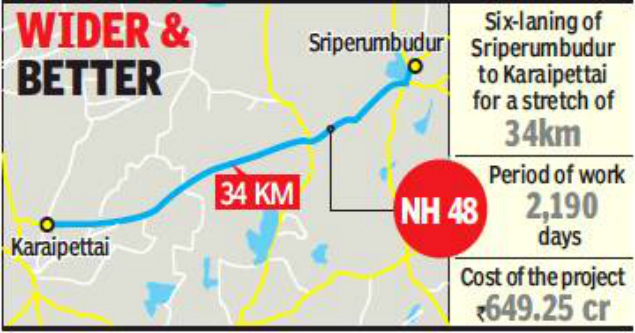
NHAI to six-lane 34 km of NH 48 at Rs 649cr

NHAI to six-lane 34 km of NH 48 at Rs 649cr

Shanmugha Sundaram. J /Oct 25, 2018

Read more at:
http://timesofindia.indiatimes.com/articleshow/66356182.cms?utm_source=contentofinterest&utm_medium=text&utm_campaign=cppst


CHENNAI: Road users can look forward to a smooth ride from Karapettai to Sriperumbudur on the Bengaluru Highway (NH 4 (new NH


48) as the National Highways Authority of India (NHAI) is all set to float tender for widening the existing four-lane road to six-lane at a cost of ₹649 crore on November 9.


NHAI
The project would be taken up under Phase V of the National Highway Development Project and executed under the Union government’s Bharatmala Pariyojana. The work would be taken up from 37km to 71km of the NH, which has a total length of 2,807 km between Chennai and Delhi. The proposed six-lane road will have wayside amenities too.

The NH was built by the Vajpayee-led government under the Golden Quadrilateral project to connect the four metros – Delhi, Mumbai, Chennai and Kolkata.


Monday, 22 October 2018

Chinnayan Nayakar tank, Kharjuraho of Tamil Nadu


A lesson in erotica: Sculptures of Tiruvannamalai tank lie forgotten

shanmugha Sundaram J / Oct 22, 2018


Long before sexual expression was considered taboo and sensuality vulgar, intimate scenes were etched into temples across the country. While some were carved in between other images of mythology, others were more elaborately displayed as found in the Unesco recognized Khajuraho group of temples in Madhya Pradesh or the Konark Sun temple in Odisha.
 In Tamil Nadu, a four-century old tank, Chinnayan Kulam, 40km from Tiruvannamalai town, stands as a testament to the celebration of erotica.
More than 100 bas-relief sculptures line the stone parapet walls around the tank 
on the outskirts of the Chinnayan Pettai village. A reflection of the fine art of the
 Vijayanagara and Nayaka period, it has survived the ravages of time. Though the tank

 was declared a protected monument by the state archaeology department in 1988, the government failed to maintain it and explore its tourism potential, especially since it has a unique story.
According to the information board at the spot, “the erotic scenes engraved on the parapet wall are not found anywhere else in the state.” It was constructed in 16th or 17th century by Chinniyan Nayakar, chieftain of Chengam, who built the tank for his daughter to educate her in the art of erotica. “The daughter was believed to be uninterested in married life but after visiting the tank, primarily meant for bathing, she is said to have changed her mind and soon bore a child,” said R Segar history professor of Government Muthurangam Arts and 
Science College, Vellore. He added that newly-weds and childless couples used to visit Chinnayan Kulam occasionally, but a taboo developed around erotic sculptures and the villagers began staying away. Confirming with the records at the state archaeological department, an official said the tank and the village were named after the chieftain. A similar tank in Ravanthavadi, unrecognized by the state, lies in a dilapidated state, said Segar.
Stressing on the ancient perspective on carnal exploration, retired deputy director of Archaeological Survey of India K Karuppiah said, “Our ancestors chose temples to educate adults about lovemaking. We can find many erotic sculptures amid gods and goddess at temples, particularly in Vaishnava temples, in Pudukottai and several other parts of the state. Sculptures of similar nature are found in the tank in plenty,” he said.
According to archaeologists and historians, erotic sculptures are categorized into sacred (depicting gods and goddess in dalliance), ritual (cult and tantric) and secular (kamasutra). The sculptures in Chinnayan Kulam come under the last group. The parapet walls contain nude sculptures of men and women in different intimate positions, including group activities and bestiality. Though the focus is on erotica, scenes from epics like Ramayana, Mahabharata, landscapes, vignettes of social life and illustrations of warriors in combat or while hunting adorn the wall.
“The sculptures provide information about the ancient civilization. There was a ‘fertility worship’ cult in 12th century and Lajja Gauri in Dharmavaram is a fine example of the cult,” said archaeologist C Santhalingam, adding that such sites should be promoted for tourism.
When sites like Khajuraho attract tourists from across the world, these tanks in Tamil Nadu are an example of a wasted opportunity.
Differing from the archaeologists that erotic sculptures were an education tool, historian Chithra Madhavan said temples reflect the worldly life. “These types of art should be promoted for tourism. They will be appreciated by people interested in it.”
The officials had fenced the tank and erected an iron gate in 1988, but it was vandalized over the years. Officials said the tank was renovated and restrooms were constructed at the site at a cost of Rs24 lakh four years ago, but the facility was damaged again. “We have sent a proposal to renovate the tank again and requested to appoint a watchman for the tank,” said M Prakasam, curator at the archaeology office in Dharmapuri.
The district administration has also asked the state archaeology department to renovate Amma Kulam at Ravanthavadi and declare it a protected site. “The tank is smaller than the Chinnayanpettai one, but the sculptures and style of architecture is the same,” said collector K S Kandasamy.  
Retired state tourism department official N Ravi said information on its historical importance, uniqueness and links to other tourism spots should be made available. “We have only talk about Mamallapuram, Thanjavur Madurai and forget that there are several lesser-known spots which show the diversity and richness of our culture,” he said. 


Monday, 8 October 2018

From small game hunting to earning big bucks, Narikuravas string new life

Narikuravas’ beads ornament business adds colour to over 2,000 families in Chengam
A tiny settlement of ‘narikuravas’ has made a difference in the lives of at least 2,000 families in the villages in Chengam in Tiruvannamalai district. The State’s own nomadic tribe, in the last two decades, has been providing a source of income for hundreds of women by engaging them in their traditional enterprise of making ornaments out of beads.
Rajapalayam is no less than a non-descript village. Located at least 50 kilometres away from Tiruvannamalai, it is home to 150 families of ‘narikuravas’. Many of them have turned employers for women from other communities in at least 20 villages in and around Chengam.
It was during the reign of former chief minister Kamaraj that `narikuravas’ were given permanent houses in Rajapalayam in Mel Ravanthavadi panchayat. Until two decades ago, their primary source of livelihood was hunting for meat and skin. As restrictions curtailed them, they soon turned to beads, making it their fulltime enterprise in the years to come.
“It was during the 90s that we started making different kinds of ornaments using beads. We used to sell them during festivals and at pilgrim spots in Tamil Nadu and neighbouring states. We found a demand for our products. So, we gradually built our business. Today, it is more like a cottage industry,” R. Thangarasu, a 47-year-old narikurava.


     Over the last two decade, they have spread their wings, expanding their business by leaps and bounds. Take Thangarasu for instance. Today, he is a wholesale dealer for bead ornaments. Inside his house are huge wooden shelves in which thousands of chains made of colourful beads, crystal, tusli, rudrashakas, padigam and navaratha stones.
He supplies these chains to big shops particularly in pilgrim destinations in Tamil Nadu, Kerala, Karnataka and Andhra Pradesh.
T Arasakumari,40, of Om Sakthi SHG was one of the role models among Narikuravas women. She inspired women in her community to turn from employee to employer. “We work not less than 10hours a day to make the ornaments. Since the demand is high, we roped in women from other villages to meet the demand and make use of the business opportunity,” she said. 
Fifty-year-old S Sekar is another entrepreneur from the community. A former resident of Rajapalayam, Sekar moved to Chengam Town to expand his business.
Thangarasu and Sekar are not alone. There are more big players in Rajapalayam and surrounding areas – Kannappan and Panneer in Chengam Town.
But interestingly, this does not stop with the narikurava community. These self-made entrepreneurs are now employers for hundreds of omen in 15 villages in the radius of 10 km. Not surprisingly, the Narikuravas have been distributing bonus or gift such as saree or household items for Deepali/Pongal for a decade now.

 Nearly 150 women in Melpuzhithur and Pakkiripalayam, who were eking out their living by rolling beedi until a decade ago, have switched over to ornament making.  “Rolling beedis took a toll on our health. But this (beads making) help to earn better, without compromising our health,” said a Muslim woman in Pakkiripalayam.
 They purchase the beads from Mathura near Delhi and Kasi once or twice a year, while the copper wire and caps are purchased from Dharmapuri and Salem districts. These raw materials are distributed among the women.
 Amudha, a resident of Kattamadu, has been making ornamentss for nearly 10 years. “I work in an agricultural field. When I return home, I make ornamentss during my leisure time after finishing domestic chores. This helps me earn an additional income to support my family,” said Amudha, who calls Thangarasu as ‘Mothalali’ (owner). She earns at least Rs50 to Rs70 a day.
 Like her, Vijaya, a resident of Thiruvalluvar Nagar in Chengam Town, uses her leisure time to make chains to earn money. This, she says, helps her meet her daily needs. “We make the ornaments while watching TV and chit-chat with neighbours,” she said.
 Vijaya’s neighbours echoed the same and added that for agricultural labourers like them, bead making has turned into a source of revenue during drought. Young girls too have been learning to make the beads during to augment family income.
 “Earlier, I used to go and supply the raw materials and collect the finished products. Now, they come to my shop and collect the raw materials and handover the chains. We collect the chains made by them once a week or a fortnight and pay them the wages,” said Sekar, a wholesale dealer. He has engaged around 500 women in the town and neighbouring villages.
 Women in the state’s indigenous tribe have formed self-help groups (SHG) and have obtained loans to the tune of Rs 2crore to build business. “It all started 16years ago. When they first approached us for loan in 2002, we hesitated to entertain them and doubted their repaying capacity. But they have proved us wrong,” said secretary of Primary Agriculture Cooperative Credit Society S Sampath.
 From avaiing loan of Rs 2,000, the Narikuravas’ societies and SHGs have grown to avail loans to the tune of Rs30 lakh each. “We are the number one society in the district. The main reason behind this is the Narikuravas here,” added Sampath. 

Fact file:
Women in villages such as Kattamadu, Ilaguni, Illavambadi, Singarapettai, Kurumapatti, Vellalapatti, Kalladavi, Neethadurai, Naradapattu, Kuppanatham, Bandreav, Ravanthavadi, Pakkiripalayam, Thiruvallur Nagar and a few other surrounding hamlets are roped in by narikuravas to make beads ornaments.

Big players in neighbouring districts - Sivakumar, Malaysia and Sankar in Vellimalai in Krishnagiri district, Gopi in Harur in Dharmapuri district. They have roped in hundreds of women from other communities to make beads ornaments in their surrounding areas.

They paid between Rs 4 and Rs 10 per ornaments (each has 108 beads) based on its variety.
  
Narikuravas buy raw materials – different kinds of beads/stones/sandalwood – from Diwanipur, Mathura and Varanasi in Uttar Pradesh. Ruthraksa from Nepal.
Copper wire and caps from Salem and Dharmapuri districts.
Narikuravas sell the ornaments from Rs 28 to Rs 50 (each).  The business is hot during December and January months.  
The ornaments sold to wholesale dealers in Tiruppur, Chennai, Madurai, Coimbatore, Tiruchy, Palani and other pilgrim spots in TN
Mandya, Bangaluru and Mysore and surrounding pilgrims spots in Karnataka, Tirupathi, Vijayawada, Hyderabad and Chittoor in AP, Ernakulam, Thiruvananthapuram, Guruvayoor, Thirussur, Palakkad, Kozhikod and several other places in Kerala.

Tuesday, 3 April 2018

Girls become mother of one or more children before attaining legal marriage age of 18


Girls become mother of one or more children before attaining legal marriage age of 18


Jawadhu Hills

Two summers ago, precisely on July 10 in 2016, a 45 year-old man tied the knot to a girl 3o years younger to him. The class X student, who was forced out of the school, was his second wife and one among the hundreds of child marriage victims in Jawadhu Hills.

With no law enforcing agency taking measures to save young girls from the clutches of the child or minor marriages, getting married at the age of 14 or 15 has become part and parcel of the lives of many girls in the tribal villages of Jawadhu Hills.

Over 70 percent of the girls, before attaining the lawful age of marriage of 18 years, have become the mother of one or more children here. However, the marriages are neatly tucked under the cover of the tribals culture and none see any wrong in it. Government officials shrug off the issue, stating that early marriage is part of their culture and lifestyle. 

Shanthi (name changed) had no say when her marriage was fixed with A Dhamodharan of Puliyamarathur village in Anaicut Taluk in Vellore district in July 2016.

She was in class X then, and discontinued from school. Her teacher found that her family had fixed the marriage only after inquiring with her brother, who was in class IV. “The groom was about 45 years-old. His family fixed the marriage with Shanthi as he did not have a child with his first wife,” said the teacher. However, the girl sent back home within a month of the marriage. She was living with her parents now in Korathur village.  

There were many like Shanthi in the 350- odd villages in the 17 panchayats in the hills in Vellore and Tiruvannamalai districts. “Over 70 percent of the married girls are victims of child marriage. They get married between 14 to 16 years,” said P Murugan of Childline in Jamunamaruthur.

They rescued a class XI girl student and XII boy student who married two months ago, he said and adding, “The entire village/community is turning against us when we try to stop child marriage. We even chased and threatened when we went to stop a child marriage in Mandaparai recently,” he said.   

Kumar (name changed), 24, a tailor in Jamunamaruthur, became father of his third child a month ago. His eldest son was studying in class II. “My wife is two years younger to me,” said Kumar. He was 16 years at the time of marriage, while his wife was 14 years. They studied upto class VIII. 

A class VI student in a government tribal residential school said that a girl of her age got married in Kovilandur two months ago. “The groom has been staying with the girl’s house for the last two months,” said the girl.

Inquiry with the locals revealed that if a boy stays in the girl’s house means that they consummated the marriage. “If the girl and the boy like each other, they can get married or stay together (living together) without getting married. It is a totally accepted practice here,” said an official in Social Welfare Department.

Child Line has an exclusive office in Jamunamaruthur to stop child marriages but its performance has been disappointing, said the official. “Last year, they managed to stop only 13 child marriages but we are not happy with the local staff, who belong to Jamunamaruthur. They prefer not to act upon complaints,” added the official.

Calling the data with health department nothing but a smoke and mirrors, a village health nurse said that they randomly entered the age of the ante-natal mother as 18 or above, to keep the records clean. “Here, the girls either lie about their age or not sure about their age. So, we will put 18 or above based on their physical appearance,” she quipped.

However, the block medical officer of Jamunamaruthur, Dr P Ram Manohar, surmising his 22 years of being in service in the hills, said that things have changed. But there is a long way to go to bail out the community from the child marriage and host of health-related issues due to early marriage.

However, there are some positive signs as many victims of child marriage want their daughters and sons to study well and escape the drudgery of the hills. “I want my daughter to study well and go for a government job. My daughter is now studying in class X,” said Kallimuthu and his wife Amutha (name changed) of Kovilanur. They got married when they were 16 and 14 years respectively.

Tribal activist and vice-present Tamil Nadu Adivasi Ammaipukkalin Kuttaiambu Leelavathi said that they have been conducting awareness programme and dissuading the practice of early marriage. However, it still prevails in several tribal communities, particularly in Jawadhu Hills, in the state. 

Graphics

32 child married in Jawadhu Hills since 2015. Of them, 13 marriages stopped in 2017. It is less than 10 percent of the total child marriages take place in the hills.  

Girls as young as 13 0r 14 years are getting married. Boys are getting married as young 16 or 17 years. Most of them consummate the marriage.

Two month ago, a class XII boy got married to class XI girl of the same school in Jamunamaruthur, according to Child Line


Theertha Kovil and Perumal Kovil in Alangayam on the foothills of Jawadhu Hills are the hotspot for the child marriage. 

Primary Health Centres in Jamunamuaruthur and Nammiyampattu records average of 45 child birth per month. A majority of mothers are victims of child marriage.
 

Village administrative officers (VAO), police and village health nurses (VHNs) are well aware of child marriages, but cease to act against the ill-practice. Thus encourage the tribals continue with their age-old practice

Health issues due to child marriage - 7 out of 10 children are malnourished in Jawadhu Hills. 40 percent of the tribals have nutrition disorder and suffer from protein deficiency anaemia, according to health department officials